What Is an OGUK / OEUK Medical? The Complete 2026 Guide
The OGUK medical — now officially the OEUK medical — is the fitness certificate you need to work offshore on a UK oil, gas or wind installation. Here is exactly what it involves.
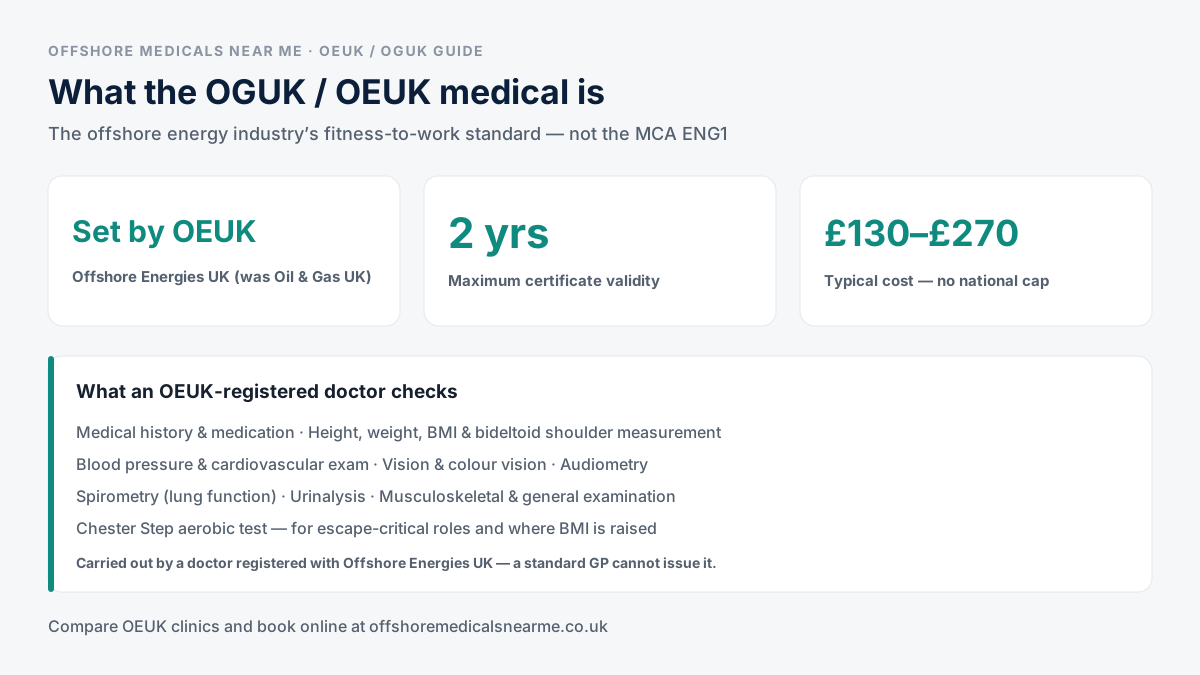
- The OGUK medical and the OEUK medical are the same certificate: Oil & Gas UK rebranded as Offshore Energies UK (OEUK) in 2021, and before 2007 it was the UKOOA medical.
- It is an offshore energy industry fitness-to-work standard set by Offshore Energies UK, not a statutory or government requirement like the MCA ENG1.
- It must be carried out by a doctor registered with OEUK as an examining physician; a standard GP cannot issue it.
- A certificate is valid for a maximum of 2 years; a doctor can issue a shorter one if a health condition needs earlier review.
- The assessment takes about 30 to 60 minutes and covers medical history, BMI and a bideltoid (shoulder) measurement, blood pressure, vision and colour vision, audiometry, spirometry (lung function) and urinalysis.
- A Chester Step aerobic fitness test is required for personnel who must be fit for emergency escape or response duties, and often where BMI is raised — but not for every candidate.
- There is no national price cap: an OGUK / OEUK medical in the UK typically costs £130 to £270.
- Operators and duty holders require a valid certificate before a worker can mobilise offshore.
OGUK, OEUK or UKOOA — one medical, three names
They all mean the same certificate. The trade body that owns the standard has changed its name over the years: UKOOA (UK Offshore Operators Association) until 2007, then Oil & Gas UK (OGUK), and since 2021 Offshore Energies UK (OEUK) to reflect the sector's move into offshore wind, hydrogen and carbon capture. Most workers and many clinics still say "OGUK medical"; the paperwork now says OEUK.
What the certificate is for
Unlike the ENG1, which is a legal requirement under the Maritime Labour Convention, the OEUK medical is an industry standard. There is no law that names it — but operators, drilling contractors and duty holders require a valid certificate in their contracts before anyone travels offshore. The medical standards are set out in OEUK's guidance for examining physicians, Medical Aspects of Fitness for Work Offshore.
The assessment has two jobs: confirm you are fit to do the work, and confirm you are fit to get yourself out — evacuate by helicopter or lifeboat, use an emergency breathing system, and cope in a place where the nearest hospital is hours away.
Who needs an OGUK / OEUK medical
- Drilling and production crews on fixed platforms, jack-ups, semi-subs and drillships.
- Maintenance, construction, inspection and ROV personnel mobilising offshore.
- Offshore wind technicians — many wind operators accept the OEUK medical, alongside or instead of the GWO medical. See the offshore wind turbine medical guide.
- Catering and hospitality crew living offshore.
- Short-term visitors staying overnight on an installation.
What the doctor checks
- Medical history and medication review — past illness, surgery, mental health, and anything that could deteriorate offshore.
- Height, weight and BMI, plus a bideltoid (shoulder) measurement used for helicopter seat and window escape. A raised BMI can trigger a Chester Step test or a restricted certificate.
- Blood pressure, pulse and a cardiovascular examination.
- Vision — distance, near and colour vision. Colour vision matters more for safety-critical roles such as crane operator or banksman.
- Audiometry — a hearing test.
- Spirometry — a lung-function test (FEV1 and FVC).
- Urinalysis — a dipstick screen for glucose, protein and blood.
- Chester Step test — a sub-maximal aerobic fitness test, required for emergency-response and escape-critical roles and often where BMI is raised.
- Musculoskeletal and general physical examination.
Many clinics also issue an EBS / helicopter-escape confirmation from the shoulder measurement. A drug and alcohol screen is a separate employer requirement, not part of the core medical. For the full walkthrough, read OGUK / OEUK medical: what to expect on the day.
Fit, restricted or unfit
Most people are certified fit for offshore work. Other outcomes: fit with a restriction (for example a shorter validity, or no emergency-team duties), temporarily unfit for a treatable issue such as high blood pressure, or — rarely — permanently unfit. A decision can be reviewed by an independent medical adviser under OEUK's arrangements.
How long it lasts and what it costs
Valid for up to two years, or less if a condition needs earlier review — see how long an OGUK / OEUK medical lasts. There is no fee cap (unlike the ENG1's £115 statutory maximum); UK clinics typically charge £130–£270, with the Chester Step test and drug-and-alcohol screening on top. See OGUK / OEUK medical cost.
How to book an OGUK / OEUK medical
You need an appointment with an OEUK-registered doctor. Rather than phoning round clinics, compare registered doctors near you with their real, live appointment availability and book online.
See live OGUK / OEUK medical availability near you Enter your postcode and compare real, live appointment times at MCA-approved clinics — book online in a couple of minutes. Find a clinic →